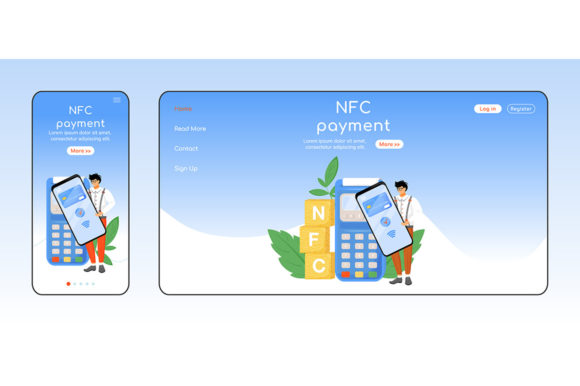
NFC Payment Adaptive Landing Page: A Modern Approach to Contactless Transactions
The rise of digital payments has transformed the way people interact with financial services. Among the most innovative solutions is the NFC Payment Adaptive Landing Page, a design that supports contactless transactions across mobile and PC platforms. This approach ensures a seamless user experience regardless of the device being used, making it ideal for fintech applications and e-payment webpages.
At the core of this design is the use of NFC (Near Field Communication) technology, which allows users to make payments by simply tapping their devices. This method is not only fast but also secure, leveraging encryption and tokenization to protect sensitive data. The adaptive landing page is built to respond to different screen sizes and input methods, ensuring that the interface remains intuitive and functional on both smartphones and desktops.
Key Features of an NFC Payment Adaptive Landing Page
An effective NFC payment adaptive landing page incorporates several key features that enhance usability and performance. One of the most important aspects is the layout, which must be optimized for touch interactions on mobile devices while maintaining clarity and accessibility on larger screens. This requires a thoughtful balance between visual hierarchy, spacing, and interactive elements.
Another essential feature is cross-platform compatibility. The design must work seamlessly across operating systems such as iOS and Android, as well as different web browsers. This involves using responsive design techniques and ensuring that all components—such as buttons, forms, and icons—are scalable and readable on various devices.
Additionally, the landing page should integrate with existing payment gateways and APIs. This allows users to initiate transactions directly from the page without being redirected to external sites. By embedding NFC functionality within the page itself, users can complete payments quickly and efficiently, reducing friction in the checkout process.
Advantages of Using an NFC Payment Adaptive Landing Page
One of the primary benefits of an NFC payment adaptive landing page is its ability to streamline the payment process. Traditional checkout workflows often require users to enter card details, shipping information, and billing addresses, which can be time-consuming and prone to errors. With NFC, users can complete transactions in seconds, significantly improving conversion rates and customer satisfaction.
Another advantage is the enhanced security provided by NFC technology. Unlike traditional card swiping, which can be vulnerable to skimming, NFC payments use dynamic tokens that change with each transaction. This makes it much harder for fraudsters to intercept or replicate payment data. Additionally, many NFC-enabled devices include biometric authentication, such as fingerprint or facial recognition, adding an extra layer of protection.
For businesses, the adaptability of the landing page offers greater flexibility in reaching different audiences. Whether users are accessing the page from a smartphone, tablet, or computer, the design adjusts to provide the best possible experience. This is especially valuable for fintech companies looking to expand their reach across multiple markets and user segments.
Use Cases for NFC Payment Adaptive Landing Pages
The NFC payment adaptive landing page has a wide range of applications across various industries. In retail, for example, it can be used to facilitate in-store purchases through mobile wallets or wearable devices. Customers can tap their phones at a point-of-sale terminal to pay for goods, eliminating the need for physical cards or cash.
In the transportation sector, this technology is already being used for contactless ticketing and fare payments. Users can tap their smartphones or smart cards at entry gates or onboard vehicles to access services. This reduces wait times and improves overall efficiency, making it an attractive solution for public transit systems and ride-sharing platforms.
Another growing use case is in the hospitality industry, where guests can use NFC-enabled devices to check into hotels, access room keys, and make payments for amenities. This not only enhances convenience but also reduces the need for physical interactions, which is particularly relevant in the post-pandemic era.
Design Considerations for an Effective Landing Page
Creativity and functionality go hand in hand when designing an NFC payment adaptive landing page. A flat color vector template can serve as a strong foundation, offering a clean and modern aesthetic that aligns with current design trends. This style emphasizes simplicity, making it easier for users to focus on the core functionality of the page.
Visual elements such as icons, buttons, and call-to-action sections should be designed with accessibility in mind. High contrast, clear typography, and consistent spacing help ensure that the page is usable for all users, including those with visual impairments. Icons should be intuitive and recognizable, reducing the need for extensive text explanations.
Performance is another critical consideration. The landing page must load quickly and respond smoothly to user interactions, even on slower internet connections. This involves optimizing images, minimizing code bloat, and leveraging caching techniques to improve speed and reliability.
Implementation and Integration
Developing an NFC payment adaptive landing page involves several steps, starting with planning and wireframing. Designers and developers must collaborate to define the layout, user flow, and technical requirements. This includes selecting the right frameworks and libraries that support NFC functionality and responsive design.
Once the design is finalized, the next step is to implement the code. This typically involves HTML, CSS, and JavaScript, along with integration with NFC-enabled hardware and software. Testing is essential to ensure that the page works correctly across different devices and environments. This includes simulating real-world scenarios such as low signal strength, interference, and varying network conditions.
Finally, the landing page must be deployed and monitored for performance and user feedback. Analytics tools can help track metrics such as conversion rates, bounce rates, and user engagement, providing insights for further improvements. Regular updates and maintenance ensure that the page remains compatible with new technologies and user expectations.
Future Trends and Developments
The future of NFC payment adaptive landing pages looks promising, with ongoing advancements in both hardware and software. As more devices become NFC-enabled, the potential for contactless transactions will continue to grow. This includes not only smartphones but also smartwatches, tablets, and even IoT devices.
Additionally, the integration of AI and machine learning could further enhance the user experience by personalizing the payment process. For example, AI could analyze user behavior to suggest preferred payment methods or detect suspicious activity in real-time. These innovations will make NFC payments even more secure, efficient, and user-friendly.
As the demand for seamless digital experiences increases, the role of NFC payment adaptive landing pages will become even more significant. Businesses that adopt this technology early will be better positioned to meet the evolving needs of their customers and stay ahead in the competitive fintech landscape.